01
Everything at the front
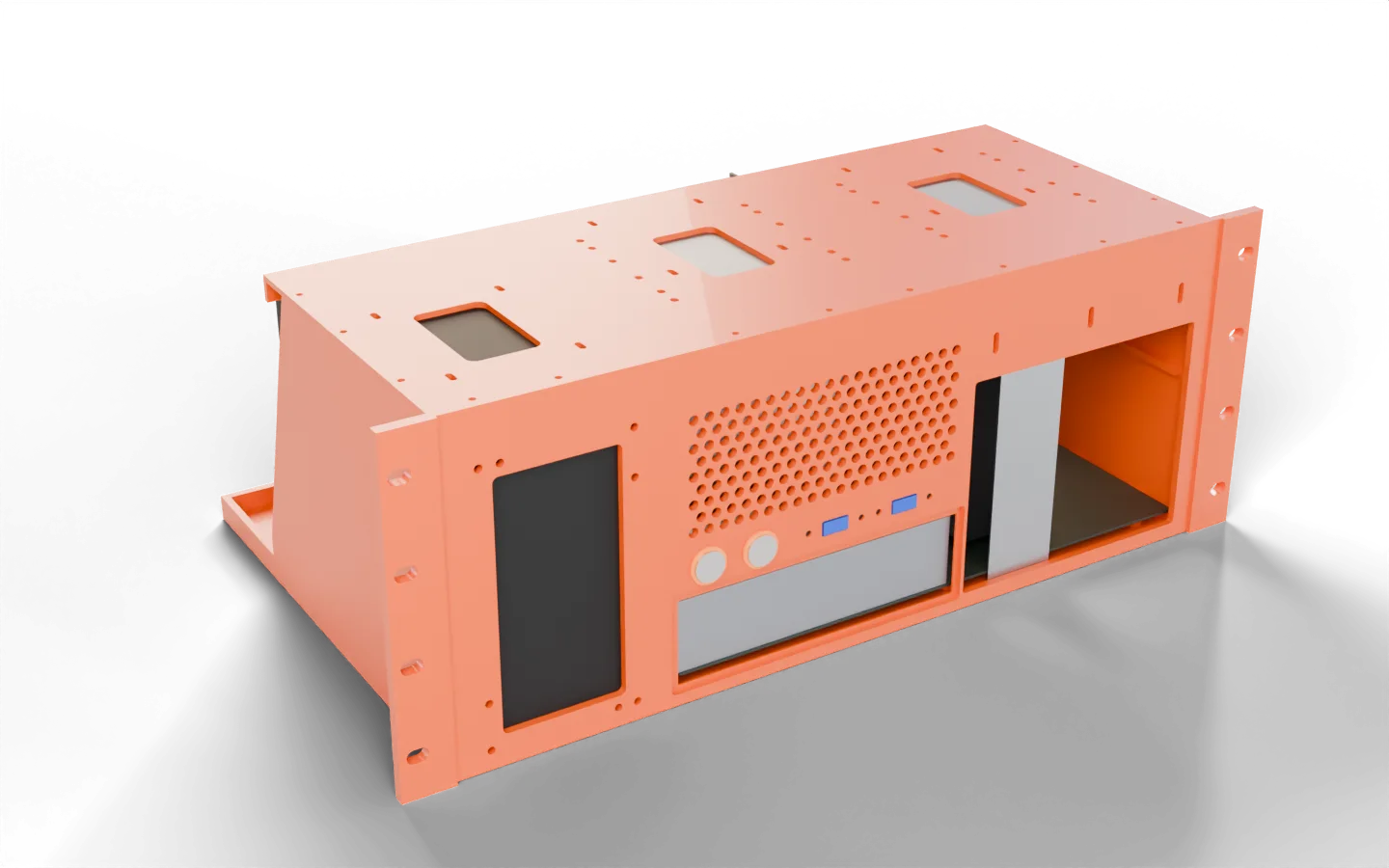
The board is turned 180°. I/O shield, expansion slots, PSU inlet and switch, two 16 mm buttons and two USB-A ports all face you. Service the machine from the cold aisle.
The motherboard is turned 180° so its I/O edge faces the front panel. Once that is done, the rear panel has no job left, so it goes, and the rest of the case shrinks to what holds the parts.
The board is turned 180°. I/O shield, expansion slots, PSU inlet and switch, two 16 mm buttons and two USB-A ports all face you. Service the machine from the cold aisle.
A floor tray, a front panel and two ears. Nothing at the back, so cards and cables can overhang the tray and air moves freely.
Bring the board you already have. ATX fits the 4U; mATX and Mini-ITX fit every height.
Seven full-height slots in 4U, four full-height in 3U, four low-profile in 2U. The 4U card shelf adjusts ±3.8 mm to suit your bracket.
Bare electrogalvanised steel as standard: rust-free indoors, nothing to chip. Want a colour? Powder coating is an option. About 2 to 5 kg, depending on the model.
Zinc conducts. The board grounds through its standoffs, and the I/O shield clips into the panel just as in a tower case. Powder-coated cases keep those contact points masked.
Up to three front drives hang under the 4U top plate. The 400 and 500 mm trays add 3.5″ bays on the floor behind the board.
The frame is riveted for strength. The parts you open are screwed: the top plate (3U, 4U) and card shelf (4U) come off with M3 screws for CPU, RAM and card swaps.
A vent field over the I/O feeds the CPU. The PSU pulls from the open side, and the open rear lets hot air leave at once.
Standard ears for cage nuts and M6 screws. The 430 mm body clears the rack opening, even with the optional side rails.
Any ATX PSU from 140 to 200 mm long, your board’s own I/O shield, and off-the-shelf 16 mm buttons and USB panel mounts. Nothing proprietary.
The 4U also comes as 11 PETG pieces that each fit a 256 mm bed. Ears and side walls are one piece, so the rack load never hangs on a joint.
The 1.2 mm front panel carries the ATX I/O aperture, the expansion slot window, the PSU mount with its opening, two 16 mm buttons for power and reset, and two USB-A panel mounts. In 3U and 4U a hex vent field sits above the I/O and feeds the CPU cooler.
The PSU screws straight to the panel using the standard ATX hole pattern and stands on the floor. There is no bracket. In 2U and 3U the panel's top flange is also the card bracket shelf.
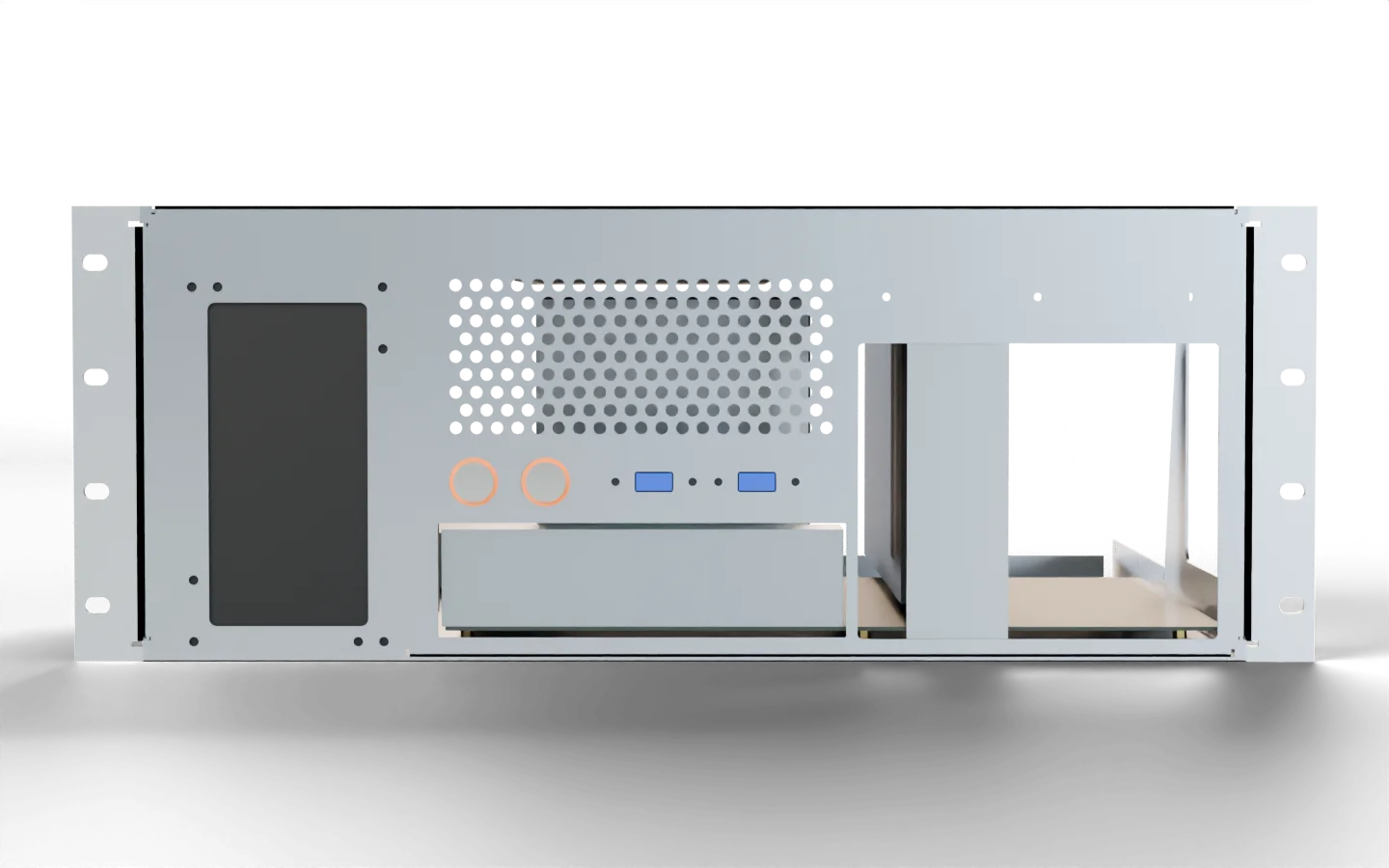
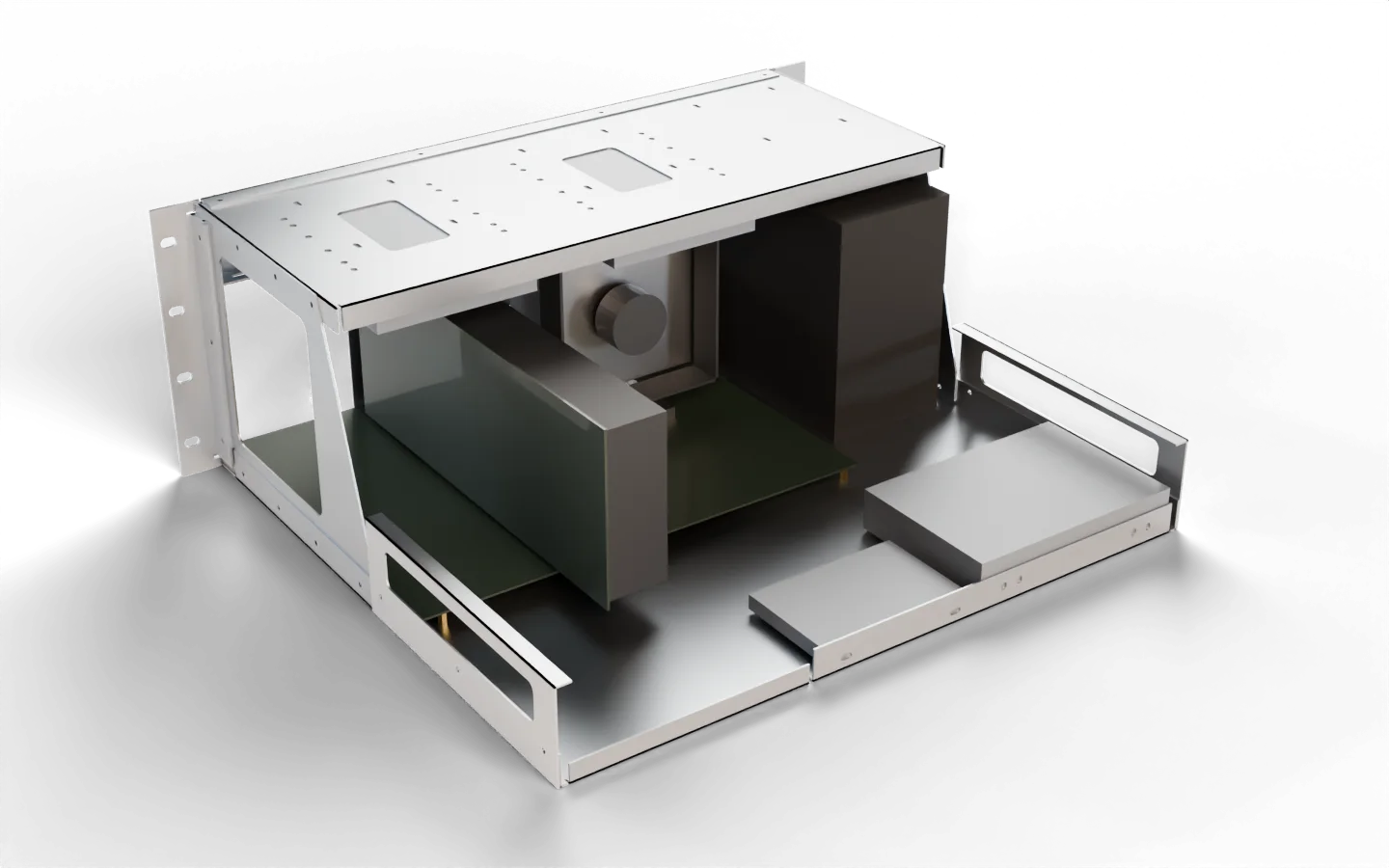
Behind the board there is only the floor tray with low flanges. Under the card zone the rear flange drops to 12 mm, so a 300 mm+ GPU can overhang the back of the tray. Cables leave through the open rear, and hot air goes straight out with them.
On the 400 and 500 mm trays the space behind the board takes floor drives. They lie on rubber pads and are screwed through the flanges from outside, so no drive cage is needed.
The case is electrogalvanised steel, with heavier 2 mm ears that carry it in the rack. As standard it ships bare galvanised: nothing to chip, nothing to rust indoors, and the zinc grounds the board and the I/O shield just like a tower case. Powder coating is available as an option, with the grounding contacts masked off.
Riveted where it carries load, screwed where you open it. Floor, front panel, ears and side gussets are riveted into one rigid frame. The top plate (3U, 4U) and the card shelf (4U) are held by M3 screws with nyloc nuts, so they come off to give you the CPU, RAM and cards without taking the machine out of the rack.
EM-CASE-R-4U-280-P is the 4U layout re-engineered for printing: a 4 mm front panel in three pieces, a floor in four tiles and a top plate in three. Each piece fits a 256 × 256 mm bed.
Each ear prints as one piece with its front panel section and a full-height side wall, so rack load never crosses a joint. Around the I/O opening the panel thins to a 1.2 mm rim, so a standard I/O shield still clips in.